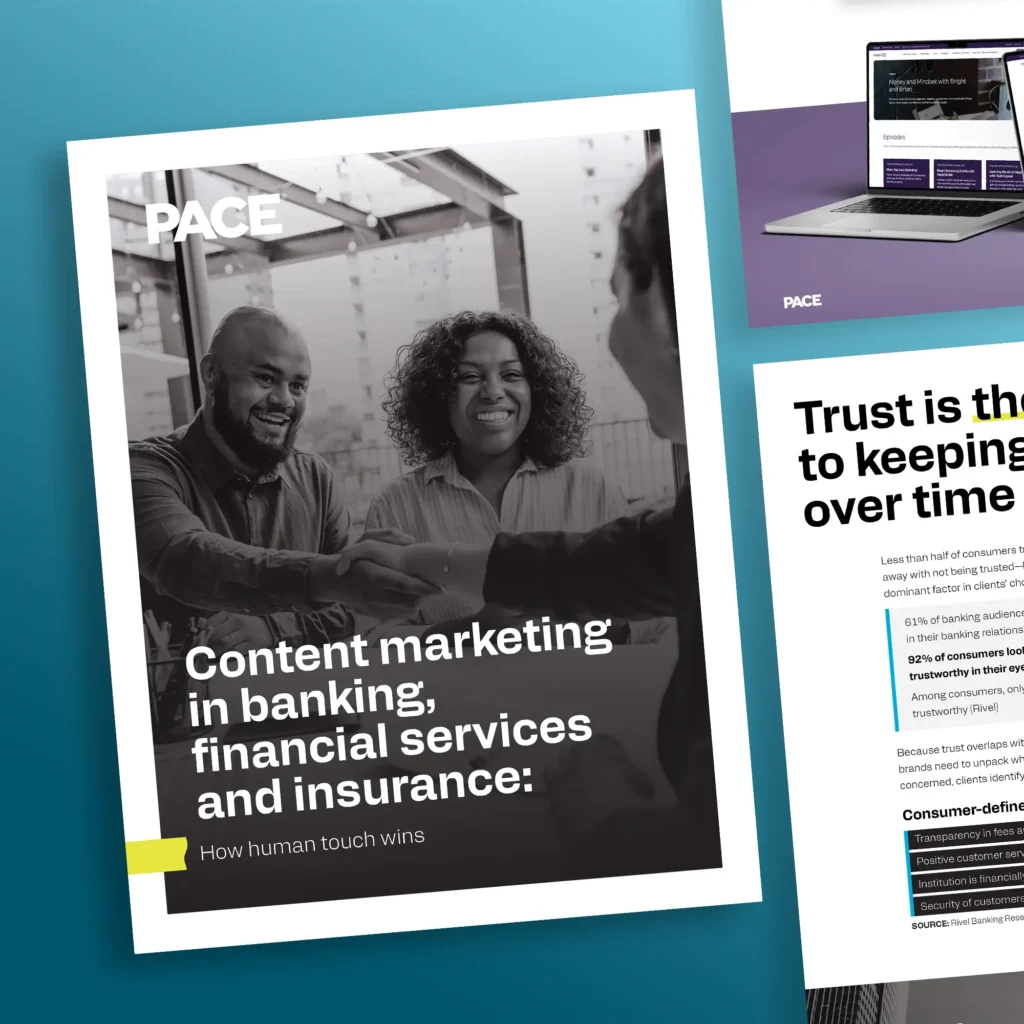

If there’s one thing brands should take away from last year , it’s that the trust economy is here, and content is the currency. In 2026, we predict winners will be brands that invest in content as an integral, strategic part of establishing trust with audiences early and often. In this article, we’ll look at content consumption, how to create content that moves audiences and strategies for senior marketing leaders to evolve their content toward building trust.
Get monthly insights like these directly in your inbox. Subscribe to our Fuel for Thought newsletter, here.
Consuming content: Audiences are discerning, not disengaged
Every day, audiences are exposed to thousands of messages in nearly every part for their physical and digital environment. More than one in four Americans consume five or more hours of media per day.
We’ve been talking about shortened attention spans for years, but the reality is that audiences are ruthlessly filtering out what’s relevant and ignoring everything else to cope with the sheer volume of content that’s available now.
In this context, content isn’t just how brands communicate. It’s how they’re evaluated. To cope with sheer volume, people are making faster decisions about what’s relevant, credible and worth their time. They’re consuming more content than ever, but the information they retain comes from sources that feel authoritative, useful and trustworthy.
This has profound implications for brands. Awareness and consideration are less distinct; they’re increasingly happening simultaneously—and much earlier. The funnel is flatter, and brand perceptions are forming long before a prospect ever engages with sales.
Marketing leaders should remain open-minded about content formats and channels to meet their audiences where they are, but that doesn’t mean being everywhere all the time.
“Winning brands build a content ecosystem with range and creativity, focused on the places their audience already goes for information, and they show up with content that’s genuinely useful to the people they’re trying to serve.”
—Rosemary Calderone, Chief Growth Officer, Pace Communications.
Case Study: The Verizon Family App—How content looks when it’s treated as infrastructure, not a campaign
It’s challenging to be a parent in a digital world. Trends, technology and teens shift by the minute, leaving many parents overwhelmed by conflicting advice online.
To help parents keep up—and to drive deeper brand attachment—Pace partnered with Verizon to produce a content hub focused on parenting in the digital age. The experience includes blog posts, educational videos and resources informed by both parenting experts and real parents.
Knowing parents were already overwhelmed by information, the strategy was to add relevance. Verizon’s Family App content hub delivered specific parenting guidance directly to customers’ phones, informed by patterns in their children’s phone and data usage, to help bridge the tech knowledge gap and spur important conversations at home.
The result: content that met parents where they were, with information they could trust and immediately apply. Consequently, the organic audience keeps growing every year, with record-high conversion signals.
Making content that moves people: It’s all about trust
While people are consuming more content than ever, they’re trusting fewer sources.
Recent Edelman Trust Barometer findings show a sustained decline in trust across governments, media and institutions. At the same time, businesses—particularly those perceived as transparent and reliable—have emerged as comparatively more trusted sources of information (if only by a slight margin).
According to Pace Chief Creative Officer Gordon Bass, it’s an opportunity for brands to play a meaningful role in filling today’s trust gap.
“As consumers increasingly question where they can turn for reliable information, brands have an opportunity to double down on producing accurate, transparent and authoritative content that builds trust.”
—Gordon Bass, Chief Creative Officer, Pace Communications
To accomplish this, brands must focus on content quality over quantity. Flooding channels with surface-level messaging only adds to skepticism. What audiences respond to instead is clarity, expertise and usefulness in content that feels grounded in real insight rather than marketing performance.
When faced with uncertainty and disruption, people actively seek authoritative information that can make their lives easier, safer or better. Content that earns trust doesn’t just inform—it reassures.
The fundamentals still matter
Here’s the paradox of modern content marketing: while the ecosystem is more complex than ever, the basics still do most of the work. Original content, expert POVs and ownable research and insights remain the backbone of effective content strategies—whatever form they take (website, video, social media, etc.). In a world dominated by surface-level messaging, deep expertise rises to the top.
Early evidence and best practices show that this type of foundational content is also most effective at ensuring brand citation in AI search results—further reinforcing its strategic value.
At Pace, this is where we excel. While we encourage brands to think broadly about what content can be and where it can live, we also know that the fundamentals are the fundamentals for a reason: They work. Strong POVs, well-researched insights, ownable thought leadership and distinctly human elements continue to move people—to think differently, feel something or take action —and people move businesses.
Case Study: Truist—Even the biggest brands need to win at the basics
When BB&T and SunTrust merged to form Truist, the newly created brand became one of the largest banks in the country. Yet awareness and understanding of its purpose lagged behind its scale. In a highly regulated industry where compliance, legal review, governance and reputational risk shape every communication, Truist needed to establish credibility quickly with both consumers and businesses while still showing up as authentic and values-driven.
Grounded in deep audience insights, Pace identified an opportunity to bring Truist’s core promise to life through the voices of its own employees and leaders. The end product was a suite of compliant, well-governed content programs supported by robust editorial hubs, video series, newsletters and digital platforms like the Truist Leadership Institute website.
The result: By pairing strong thought leadership with human perspective, Pace helped Truist build trust at scale. As our results demonstrate, Truist was able to show—not just say—what it stood for, reinforcing trust across touch points.
Strategies for senior marketing leaders
If content is still treated as a downstream executional task, it’s time to rethink that model. In 2026, content should be involved earlier—in strategy, planning and budgeting, and decision making.
Consider:
- Is your foundational content strong enough?
Credibility must be earned. While bylined blogs, white papers and long-form POVs may feel traditional in the era of TikTok and short-form video, industry research shows that these assets are still highly valued by search engines, AI tools and discerning audiences alike. For example, a recent study showed articles over 2,900 words averaged 5.1 AI citations, while those under 800 received 3.2. - Does your content uncover and address a fundamental truth for your audience?
The most effective content doesn’t just respond to trends—it reflects a deep understanding of audience needs, fears and motivations. - Does your content provide real resources or solutions?
Usefulness is a differentiator. Content that helps people make sense of complexity builds loyalty over time.
In 2026, content is an opportunity to lead
Brands have an opportunity to establish themselves as trusted sources of information, to build community rather than division and to provide more value than ever before. Content that earns trust isn’t platform-specific or channel-specific. It’s consistent, credible and—most importantly—human.
Content isn’t a channel. It’s the connective tissue between brand, audience and business growth. The brands that win will be the ones that respect their audience’s intelligence, show up with clarity in moments of uncertainty and invest in content that truly matters.