
Everyone has problems content can solve. Most of us are proactively looking for valuable, relevant information via social media feeds, generative AI, search engines and other sources. Yet consumers rarely—if ever—set out on a journey hoping to encounter content marketing along the way.
We’ve learned—through more than 50 years of content creation, activation and optimization—that effective content moves people. People, in turn, move business. So even as audiences set out looking for answers (not content marketing), the journey is all about content.
But that’s where things get tricky, as a few data points will illustrate.
- There’s more content out there than ever before. For instance, the internet grew by 32% in 2025 alone.
- Audiences are spending more time with content—up to 12 hours per day in 2025, compared to 8 hours per day in 2023.
- Audience satisfaction with content is at a historic low. As an example, consumers trusted only 41% of the content they encountered online in 2025. The majority say they have less confidence in content they consume than ever before.
This snapshot hints at a huge opportunity. Even as audiences consume more, they’re hungry for higher quality, greater relevance and deeper connection. The brands that can deliver are reaping the rewards, as we’ll illustrate throughout this article.
This guide explores the current content marketing landscape in 2026 (and how and why to create content marketing that matters). Read on to explore the following topics in detail:
- What is content marketing?
- Why content marketing is worth the investment
- The practical, tactical benefits and ROI of content marketing
- Core truth: All audiences engage with content
- Smart brands use content as a guide on the entire customer journey
- Content marketing in the age of generative AI
- Content marketing is an effective, scalable road to customer engagement
What is content marketing?
Content marketing is about adding real value to real audiences. It’s a strategic marketing approach to create and distribute content that both serves the audience and fulfills a marketing purpose. That marketing purpose could be to attract an audience, to educate consumers, to drive engagement on social channels or even to build affinity through entertainment.
Whatever the purpose, content marketing is about helping your audience solve problems in an organic way. Unlike traditional advertising, content marketing builds trust, credibility and authority by offering information that addresses the target audience’s current interests first rather than focusing on your organization’s sales/promotional message.
The Pace POV
Content marketing serves as a bridge between businesses and their audiences. It provides valuable information that helps consumers make informed decisions. When brands offer consistent value, they position themselves as industry leaders and trusted advisors, resulting in increased customer loyalty and advocacy—not just audience exposure to their messages. In 2025 alone, we saw this type of content double audience attraction while reaching 4-8 times the engagement our clients had experienced before.
Why content marketing is worth the investment
Content is a scalable way to earn trust, even in a time of historically low confidence in media. Audiences are less trusting in brands and ads than they used to be—but they still trust credible, useful information. As AI slop grows in volume, high-quality content becomes a tangible trust differentiator. Ads reset every time you stop paying. But trust compounds through great content.

This is how content functions as a long-term investment, not just a single-time expense. The best content appreciates, even as paid media loses value instantly. When brands are looking to maximize market spend, they can take confidence in content’s staying power.
Content also adds value in its ability to power a variety of marketing channels. Distribution amplifies value for top content, but the content is where that value originates. With search engines, as an example, the majority of top-ranking content is not new. It’s content that has proven value over time.
Content’s staying power hinges on its alignment with how people actually make decisions. Buyers in both B2B and B2C settings expect (and prefer) to:
- Educate themselves before they talk with salespeople
- Shop different options on their own timelines
- Have brands adapt to meet them where they are in the decision-making journey
- Feel empowered, not mystified, in the process
The longer the purchase cycle, and the more considered the decision is, the more critical content becomes. And if your brand isn’t educating the buyer, a competitor will.
The Pace POV
Content is a proven path to build ownership of your story, and even your audience’s journey. Even when spend is gone, content ownership remains.
As an example, one of Pace’s financial clients used marketing dollars to drive visitors to a new podcast. Within six months of the podcast’s launch, one visitor discovered the podcast, promptly listened to every episode published to date (owned content)—and then transferred their investment portfolio to that brand, based on the trust that owned content had instilled.
The practical, tactical benefits and ROI of content marketing
Any brand can create audience value through content. And any brand that creates audience value can experience increased brand value in return. Content marketing fuels continuous growth and long-term impact in numerous practical ways:
Increased brand visibility
Despite the record-high quantity of content in 2025, one Pace tech client doubled visibility last year, cutting through the noise with content that showed up where audiences wanted answers.
Enhanced audience engagement
Remember that figure about U.S. consumers spending up to 12 hours daily on content? It’s ample evidence that the audience appetite is there. Brands that show up on relevant channels, with stellar content, will win not just attention but time with those information-hungry audiences.
Lead generation
Valuable content attracts potential customers and nurtures them through the decision-making journey. One of Pace’s insurance clients used content to generate more than 2.2 times its goal for lead generation (resulting in more than three times its sales goal attributed to content). Results are similar in other industries as well. 74% of marketers say that content helped them generate leads in 2025.
Heightened loyalty
Historically, more than half of marketers attribute brand loyalty to content marketing. Valuable content encourages audience interaction, yielding higher engagement rates and customer retention. Three of the five top touchpoints between brands and their audiences are content-driven (or content and nothing else) according to Adobe’s 2025 customer loyalty survey.
Amplification of credibility
Insightful content positions your brand as an industry expert. Thought leadership helps both customers and competitors view the content creator as an authority in their field. Brands that create ownable content—content that could only come from an entity like theirs—continue to hold a larger share of voice and market.
Improved findability
High-quality content contributes to better search engine rankings and more organic traffic. While generative AI has changed the game for content discovery, generative engines reward smart content creators more than anyone else. Keep reading for more on that.
Cost-effectiveness
Content marketing engages larger audiences for fewer dollars. According to HubSpot’s 2025 state of marketing report, content outranked all paid tactics for effectiveness.
Because content plays a long-term role in the customer journey, it takes diligence to calculate content’s return on investment (ROI). However, tracking metrics such as repeat content visits, time spent on-site/on-page, on-page conversions and leads generated provide tangible insights into its effectiveness at fueling business growth.
Core truth: All audiences engage with content
Effective content marketing centers on an audience’s needs, wants and desires. Content marketing has proven valuable for all main audience categories:
- Consumers (B2C): Consumers look to content for both entertainment and answers. Consumer-oriented content can move the audience to action by addressing pain points, providing solutions and building emotional connections. Videos, podcasts, social media posts, blog articles and emails are all highly effective formats for reaching most consumers.
- Businesses (B2B): B2B content marketing targets other businesses by offering industry insights, data-driven reports and problem-solving content. This segment is looking for solutions to professional problems. Just like consumers, professional audiences engage with video, social content, email and so on. They also show high interest in white papers, case studies and webinars as they look for solutions in their work.
- Employees (B2E): Internal content marketing focuses on engaging and informing your organization’s employees. This includes company newsletters, internal blogs and training materials. Authentic employee storytelling is particularly powerful across all channels and media formats.
The Pace POV
The bigger the decision your audience is making, the more willing your audience will be to engage with marketing content. If you’re buying a sandwich, you probably don’t need a white paper about it. If you’re buying a property, the equation changes. This means there’s value in short- and long-form content alike regardless of the audience segment.
As long as it answers an audience need, content is valuable. For several years in a row, one of Pace’s insurance clients has attributed over $30M in annual revenue to a series of in-depth white papers (not the content most consumers immediately embrace).
Smart brands use content as a guide on the entire customer journey
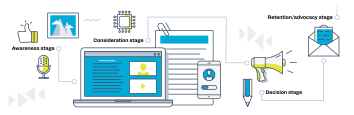
Content marketing isn’t just about first impressions. It spans the entire funnel. Just as certain content formats are better suited for certain audience segments, different types of content will better serve customers at different points of their journey.
The customer journey is a nonlinear process spanning stages of awareness, consideration and decision-making. Crafting content that resonates with each stage enhances the chances of conversion. Here’s a breakdown of content formats and channels for different stages:
- Awareness stage: In this stage, focus on creating informative and engaging content that addresses common pain points and questions your audience might have.
- Social/UGC: Social and user-generated content (UGC) capture audience attention upfront in shareable ways. Paid, organic, influencer and community content are all effective at this stage of the decision-making journey.
- Blogs, testimonials/success stories: Ideal for awareness and consideration stages, these formats provide easily digestible information and insights.
- Videos and podcasts: Engaging formats suitable for all stages, video and audio content captures attention and conveys information audiences can consume casually.
- Consideration stage: Provide in-depth content that showcases your expertise and offers solutions.
- Owned content hubs: The majority of the decision-making journey takes place as audiences gather information before talking with a salesperson. Websites and owned content hubs are brands’ best chance to influence this leg of the journey.
- Infographics and interactive content: Almost 50% of consumers prefer interactive content, making it ideal for simplifying complex information in the awareness and consideration stages.
- White papers and webinars: Perfect for the consideration stage, white papers and webinars offer in-depth knowledge and solutions. Almost 60% of content marketers report that virtual events and webinars produced the best results.
- Decision stage: Offer content that highlights the unique value of your products or services.
- Testimonials, reviews, product demos and comparison guides: Today, more than 99% of consumers read reviews before making a purchase decision. Additionally, most customers value testimonials as much as personal recommendations from their friends.
- Retention/advocacy stage: Maintain customer engagement through content that nurtures loyalty.
- Email campaigns: 80% of consumers are more likely to purchase from brands that engage in personalized advertising. Email campaigns, for instance, are not only effective for offering that personalized content to your audience members but also for nurturing leads and retaining customers.
Content marketing in the age of generative AI
Generative AI is inseparable from content marketing today. Every stage of the content journey changes when users engage with AI.
First, there’s content creation. An estimated 40% of all web content added last year was generated by AI. It’s not just creation that has changed, either. The plunge in trust mentioned above is tied to the rise of AI-generated content and its lack of authenticity.
Then there’s content discovery. LLMs and traditional search engines (Google, Bing, Amazon) are all using AI to summarize and synthesize existing content. This delays user interactions with branded content (or human-made content in general). The rise of LLMs worried content marketers early in 2025, but it helps a host of consumers and brands as well. Website visitors who first engage with LLMs make more progress on the decision-making journey, take action more often and convert at more than three times the rate of other visitors.
SEO—a close cousin to all digital content—has also changed (to phrase it mildly). It’s increasingly important to assess content without counting clicks. The interplay between generative engine optimization (GEO) and SEO makes it more important than ever that content moves the audience forward in their journey and empowers them to take action.
The Pace POV
Humans might hold less share of voice now, but they still hold nearly 100% of the decision-making power. That’s why we hang our hats on human storytelling, whatever the brand, audience, content channel or marketing purpose.
LLMs don’t stop human consumers from visiting Netflix or reading Vogue. If you’re creating content an audience wants, the audience will move beyond generative summaries to get it. AI-generated content is getting better and better at resonating with humans, but human audiences still want something human to latch onto.
Content marketing is an effective, scalable road to customer engagement
At the end of the day, content marketing equips brands to connect with their audiences on a deeper level. The brands that create helpful, relevant and consistent content are the ones that foster trust, establish authority and drive sustainable growth.
Content Marketing Institute founder Joe Pulizzi often says, “Don’t build your brand on rented land.” Content is a proven way to build ownability into the marketing ecosystem. It’s also the only way to add audience value without products or services.
So keep creating great content. There’s a hungry audience looking for it.