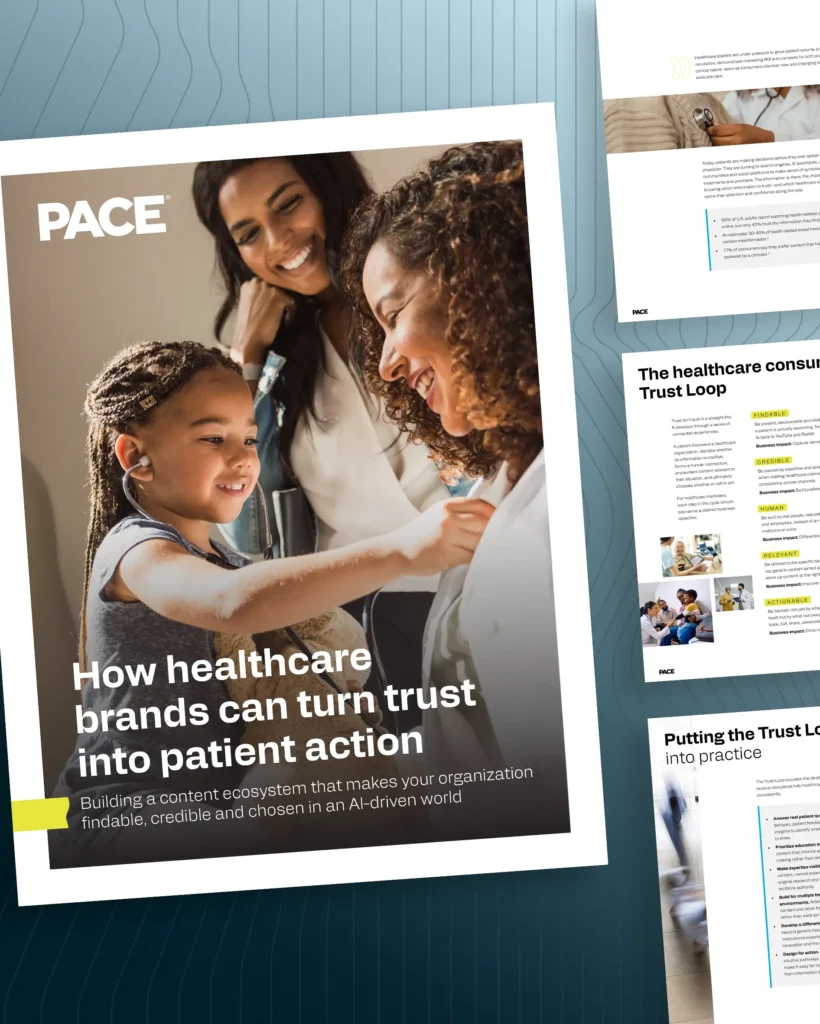

Key takeaways
- Patients are making healthcare decisions long before they schedule an appointment. An effective content strategy shapes those decisions across search, AI and digital experiences.
- Healthcare organizations should stop treating content like campaigns and start treating it as connected ecosystems. Connected content ecosystems create better patient experiences while improving discovery, engagement and retention.
- In an AI-powered search landscape, visibility and trust are not separate strategies. Organizations that consistently provide credible, discoverable information will earn both.
- Pace helps healthcare organizations integrate content strategy, audience planning, content operations, experience design and performance measurement so every interaction works together to move audiences toward action.
Healthcare marketers have spent years perfecting campaigns: service-line promotions, awareness initiatives, acquisition efforts and brand campaigns designed to drive immediate results. Those efforts still matter, but patient behavior has changed.
Patients don’t move through healthcare according to a marketing calendar. They move through moments of uncertainty: a new symptom, an unexpected diagnosis, a treatment decision or the search for the right specialist.
Those journeys begin long before a patient ever interacts with a provider. They begin with a search or a patient story. More and more, they begin with a question asked of an AI assistant.
According to eMarketer’s 2025 healthcare consumer research, more than half of consumers have used digital channels to self-diagnose a medical condition, relying heavily on search engines and health information websites to guide their decisions. Patients are forming opinions and preferences and building trust, all before they schedule an appointment.
This has a clear implication for healthcare brands. Organizations that deliver credible, helpful content consistently have an opportunity to influence decisions at every stage of the patient journey, before, during and after care.
The healthcare organizations seeing strong results are making content part of their operating infrastructure. They’re building connected systems of educational resources, physician expertise, patient stories and service-line information that help patients find the right answer at the right moment.
Trust is built through discoverability
Healthcare has always been different from other industries in that patients are evaluating more than products or services. They’re making decisions during some of the most vulnerable moments of their lives, often during moments of uncertainty. Trust influences everything from provider selection and treatment decisions to long-term loyalty and advocacy.
Today, those decisions are being made before a patient speaks to a physician. People are turning to search engines, AI assistants, online communities and social platforms to make sense of symptoms, treatments and providers. The information is there; the challenge is knowing which information to trust.
Recent Pew Research Center research found that 22% of Americans use AI chatbots for health information at least sometimes. Among those users, 48% say AI is highly convenient, but only 18% say the information is highly accurate. Consumers are getting answers faster than ever, but speed doesn’t necessarily create certainty.
This is the opportunity for healthcare brands. As AI becomes a primary gateway to information, healthcare organizations must ensure their expertise is discoverable wherever patients are researching. That means creating content that is structured, authoritative and trustworthy enough to be interpreted by AI-powered search experiences.
In this environment, visibility becomes a driver of trust. Every time a patient encounters your organization in search results, AI answers or educational content, you have another opportunity to reinforce credibility. Visibility doesn’t replace trust; it helps earn it.
SEO used to be about rankings. Today it’s about becoming a source that patients and AI recognize as credible enough to recommend.
We create campaigns—patients experience journeys
As the patient journey evolves, healthcare organizations are assessing whether they are organizing content around marketing channels rather than patient needs. Marketers often build separate plans for website strategy, email strategy, social strategy and content strategy, all operating independently. But patients don’t think that way.
Someone researching knee pain may discover your organization through Google, watch an orthopedic surgeon explain treatment options on YouTube, subscribe to a newsletter after downloading a recovery guide and schedule an appointment weeks later. After surgery, they may return for rehabilitation advice or wellness resources. To the patient, those interactions feel like one relationship, not separate marketing tactics.
Every interaction shapes confidence. This is why leading healthcare organizations are shifting from campaign planning to connected content strategies that support patients across the entire care journey. They understand that the answer is not more content. Better-connected content is.
Rather than creating disconnected content assets, brands should build integrated systems that support audiences across the full healthcare journey, including:
- Discovery and awareness
- Education and consideration
- Trust-building and emotional connection
- Conversion and access to care
- Retention and long-term engagement
This focus reflects broader changes in consumer expectations. According to PwC’s 2025 U.S. Healthcare Consumer Insights Survey, consumers now expect personalized, accessible experiences across the board that mirror those provided by leading consumer brands.
Why content ecosystems outperform content campaigns
At Pace, we’ve seen firsthand how healthcare organizations benefit when they begin treating content as a connected ecosystem rather than a collection of channel deliverables. Every channel plays a role, search drives discovery, social extends reach, and stories build emotional connection. But when they work together, they create a consistent experience that strengthens trust over time.
Rather than repeatedly introducing themselves to new audiences, healthcare organizations have the opportunity to build ongoing relationships that deepen with every interaction.
For one regional healthcare system, Pace helped redesign its content strategy around the patient journey (rather than channels). The opportunity was to connect existing content, physician expertise, search behavior and service-line priorities into clearer pathways for patients. The work created integrated content pathways that increased organic engagement while improving access to high-priority service lines. In these environments, content becomes a strategic asset that supports patient acquisition, engagement and retention simultaneously. Creating more content cannot create the same environment, one where the conditions are ideal for building trust.
The most effective ecosystems are also personalized with purpose. Healthcare consumers today expect content that reflects their needs and care journeys. Organizations that use audience insights to deliver more relevant experiences are strengthening relationships by demonstrating a deeper understanding of the people they serve. For healthcare marketers, personalization is more than a technology feature, but a way to make the patient relationship feel more relevant.
At Pace
When building content ecosystems, many organizations end up producing more content and miss the real lift. The real challenge Pace helps solve is aligning audience insights, SEO and AEO strategy, physician expertise, content governance, personalization, analytics and channel orchestration into one operating model. That is where content becomes infrastructure: not a set of assets, but a repeatable way to help patients find answers, feel understood and take the next right step.
This is our specialty as a content marketing agency. Pace helps healthcare organizations bring these disciplines together through integrated content strategy, audience planning, content operations, experience designand performance measurement.
What healthcare leaders should prioritize next for their content strategy
The good news is that the healthcare organizations best positioned right now aren’t necessarily those with the largest marketing budgets. The healthcare organizations seeing the strongest results in the current landscape are building their systems around the patient POV.
As patient expectations continue to evolve, healthcare leaders should focus on several priorities:
- Shift from isolated campaigns to connected content ecosystems.
- Align content strategies to patient journeys, rather than channels.
- Balance SEO, AEO and discoverability with emotional storytelling.
- Invest in personalization that increases relevance and engagement.
- Measure patient behavior and business outcomes, instead of content performance only.
- Build systems designed to create long-term trust, access and loyalty.
- Connect content performance to business priorities (e.g., new patient growth, appointment starts, service-line growth, patient retention).
Healthcare marketing today is defined by organizations that create the most trusted content, deliver it consistently across the patient journey and ensure it can be found wherever patients seek answers. The healthcare organizations that are leading turn content into a relationship system that moves patients from uncertainty to confidence, from confidence to care and from care to long-term trust.