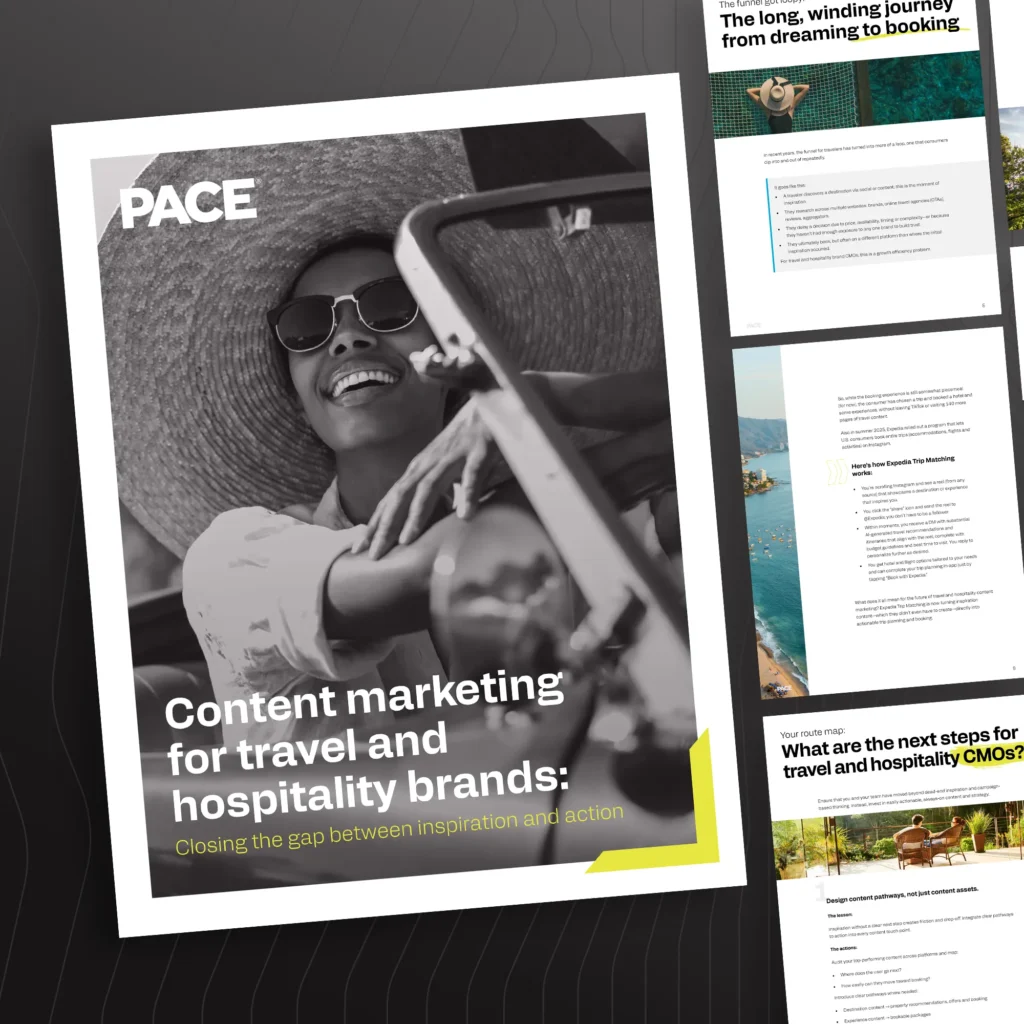

Marketers across industries are rethinking the customer journey as the landscape continues to shift. At Pace, we’ve seen this shift especially pronounced in the travel and hospitality industry. The product has always been an experience, which means the path to purchase has never followed a simple, transactional model.
In recent years, the conversation has moved beyond the funnel toward journey-based thinking. We see this with our own clients at Pace, as brands look for ways to better align with how travelers actually plan and book today.
As a result of this shift, content is no longer limited to early inspiration. It has become the layer through which travelers experience a brand long before and long after a booking. In a journey defined by loops, signals and multiple entry points, content is where brands gain a competitive advantage.
In this article, we examine how journey thinking in the travel industry is evolving, what that means for content and how brands can adapt to stay relevant.
When the funnel still worked
The funnel once provided a useful framework. It helped teams visualize stages, assign KPIs and track performance from awareness through conversion. In travel, it reflected a more predictable path to purchase.
Travelers searched for destinations, compared options and moved toward booking in a relatively direct way. And content sat at the top of the funnel, as inspiration. This structure created clarity for marketers, but it also limited how content was used. In this scenario, content informed the journey rather than shaping it.
Nonlinear, inspiration-led journey: Journey-based thinking
The way people plan travel today looks very different. Travelers now encounter inspiration passively: a destination surfaces in a social feed or maybe a recommendation appears in an AI-generated list. These moments are saved, revisited, compared and validated over time.
The shift away from the funnel reshapes the journey itself, with inspiration and conversion potentially happening in the same moment. A traveler can move from a short-form video to a booking page in a single session or save that content and return later through a different channel. The journey is fragmented, recurring and heavily influenced by content across platforms.
As a result, content is developed and managed differently. Instead of producing individual assets tied to campaigns, brands need to adopt journey-based thinking and build ecosystems that support the full customer journey across touchpoints.
AI is accelerating the shift toward journey-based thinking
The first impression of your brand may no longer be your website or your ad; it may be how AI surfaces you.
The complexity of the journey is increasing as AI becomes more embedded in how travel decisions are made. Agentic AI introduces a new dynamic by acting on behalf of travelers in discovery, comparison and planning.
These technologies are reshaping the travel landscape, influencing how options are surfaced and evaluated. At the same time, there may be a near-term future where AI-powered agents play a primary role in trip planning and booking decisions.
How brands compete has evolved. Content now needs to perform for both human audiences and the systems that surface information for them—systems that interpret, rank and recommend on a traveler’s behalf.
Visibility is no longer driven by how well a brand captures attention through paid social, display or mass-reach advertising. It is determined by how effectively content shows up, holds relevance and gets selected within those systems.
Content as infrastructure
Much of the journey now happens in moments brands can’t see or track, whether that’s saved posts, shared links or AI summaries. Influence is happening off the grid.
And yet, each of these interactions carries more weight. In a journey defined by multiple entry points, each touch point shapes perception and influences the next step, whether that step happens immediately or weeks later. Integrating touch points to create cohesive customer experiences across channels is where brands can meet customers.
Content plays a central role here. It delivers the experience while also providing the information, the reassurance and the trust that travelers need at different moments.
This means content is no longer a campaign output. It’s infrastructure. Content is always on, interconnected and responsible for carrying the journey forward. When it’s working properly, it works like a system.
What journey-based thinking means in practice
The real question is how to translate journey-based thinking into something actionable. The customer experience is often described in broad terms, but it comes down to how well a brand meets travelers’ needs.
In practice, that means content needs to do more than attract attention. It needs to support travelers as they move through different phases of planning:
- Inspiration helps them imagine the experience.
- Utility helps travelers navigate logistics and make informed choices.
- Trust helps them feel comfortable moving forward.
At Pace, we’ve focused on content that is structured, searchable and rich in context—content with depth that supports both discovery and evaluation. These elements work together across the journey to create that cohesive customer experience.
Example: What an ecosystem looks like in practice
One of the most effective ways to build a connected content ecosystem is to align every touch point around how travelers actually move through planning, not how campaigns are typically structured.
In our work with a travel client, we leaned into emotional, value-focused storytelling. By sharing the stories of the travel brand’s members as they embarked on new adventures, we inspired other members to start planning their next trips. That meant developing a system that could support inspiration, planning and booking across channels and formats including:
- A content hub that shared local travel content for each member state
- Print and digital magazines that were versioned for each member state
- Short-form social and video stories that inspired members to plan new trips
- An SEO strategy that elevated the brand’s advice, bookings and trip offers
- A refreshed email program that reflected how traveler content needs were evolving
- Robust program analytics that aided in optimizing the content strategy
The impact reflected how a connected system can perform when each piece works together. The results:
- 94% increased click rate YoY
- 81% growth in email subscribers
- 4x uptick in organic traffic
This kind of approach reinforces the role of content as infrastructure. Each element supports a different moment in the journey, while contributing to a broader system that helps travelers move forward on their own terms.
The bottom line
Journey thinking is evolving. The shift is playing out in real time as the journey becomes more dynamic and influenced by the content people encounter along the way.
For travel and hospitality brands, this creates an opportunity to rethink how content functions across the business. The brands that are gaining a competitive advantage are treating content, whether social videos, content hubs or print magazines, as the connective layer of the journey.
When approached this way, content supports discovery, informs decision-making and extends the experience beyond the trip itself. It becomes a consistent presence that helps brands show up in the right moments and remain relevant as the journey unfolds.